
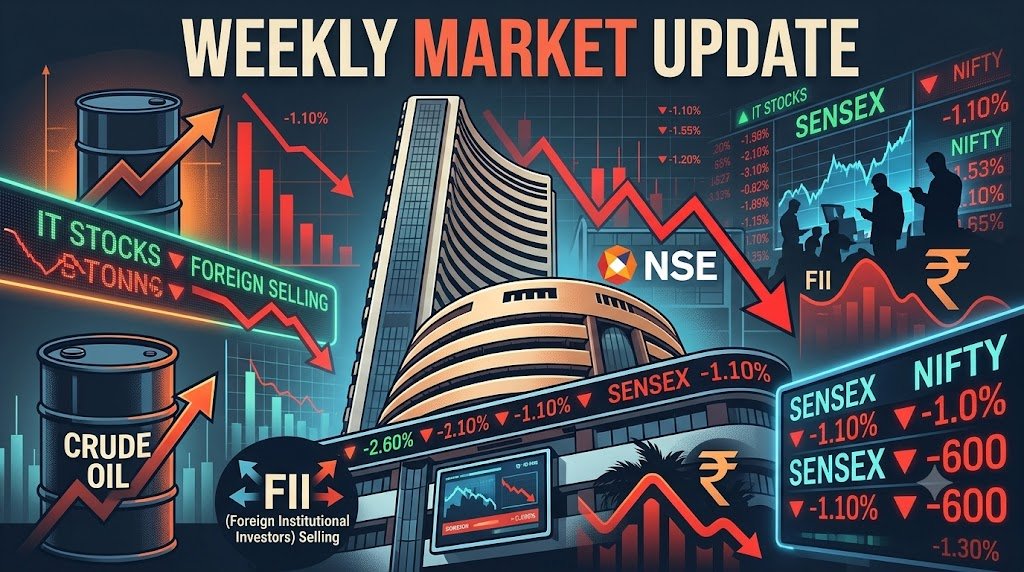
Mumbai, Oct 31: The Indian stock market ended the final week of October on a positive note after several sessions of ups and downs. Selling in IT stocks, rising crude oil prices and uncertainty in global markets kept investors cautious, while fresh buying in pharmaceutical, healthcare and select heavyweight stocks helped the benchmark indices recover.
The week reflected the challenges investors face in balancing domestic growth opportunities with international economic uncertainties. While some sessions began with sharp declines, buying interest returned towards the end of the week, helping the Sensex and Nifty regain momentum.
For the week ended October 30, the Nifty 50 gained 453.10 points, or 2%, to close at 23,053.10. The BSE Sensex advanced 1,335.70 points, or 1.83%, to settle at 74,459.53. The recovery brought some relief to investors after the previous week’s weakness.
A Week of Market Ups and Downs
Trading remained uneven throughout the week as investors reacted to global developments, corporate earnings and movements in crude oil prices.
At the beginning of the week, selling pressure in selected stocks affected market sentiment. During one session, the Sensex fell around 601 points at the opening bell as IT shares came under pressure. Concerns over rising energy prices and overseas market weakness added to the cautious mood.
However, the selling did not continue throughout the week. The market witnessed fresh buying in selected heavyweight stocks, while IT shares also attracted interest during subsequent sessions. On another trading day, the Sensex and Nifty opened higher as investors focused on corporate earnings and improving sectoral performance.
The contrasting movements highlighted how quickly investor sentiment can change in response to domestic and international developments.
IT Stocks Face Pressure Before Recovering
Information technology stocks remained in focus during the week. Initial selling reflected concerns about global technology spending, overseas demand and uncertainty surrounding artificial intelligence investments.
However, buying interest returned towards the end of the week, helping the Nifty IT index gain 1.91% over the five trading sessions.
The performance of IT companies is particularly important for India’s economy because the sector contributes significantly to employment, exports and foreign exchange earnings. Demand for artificial intelligence, cloud computing and digital transformation could create fresh opportunities, although cautious spending by international clients remains a concern.
Rising Oil Prices Keep Investors Cautious
Crude oil prices remained a major concern for the stock market. Rising international oil prices increased worries about India’s import bill, inflation and business operating costs.
Higher fuel prices can affect industries such as aviation, transportation, logistics, chemicals and manufacturing. For small businesses and MSMEs, increasing energy and distribution expenses can put additional pressure on already tight profit margins.
Investors therefore continued to monitor global oil prices while assessing their possible impact on corporate earnings and the broader economy.
Pharma and Healthcare Stocks Lead the Gains
While IT and banking shares experienced fluctuations, pharmaceutical and healthcare stocks emerged as strong performers.
The Nifty Pharma index gained 7.09% during the week, while the healthcare index advanced 6.91%. Automobile, media and real estate stocks also recorded gains.
The strong performance of healthcare-related shares reflected investor interest in businesses supported by consistent demand, domestic consumption and export opportunities.
FII and DII Activity Supports Market Sentiment
Foreign and domestic institutional investors continued to influence market movements.
Foreign Institutional Investors (FIIs) returned to buying during several sessions towards the end of October, although their overall investment activity remained volatile. Domestic Institutional Investors (DIIs) provided additional support, helping absorb some of the selling pressure.
For the broader market, sustained domestic investment remains important because it can help maintain liquidity and investor confidence when overseas investors become cautious.
What the Market Movement Means for Businesses
The stock market’s performance also offers important signals about business confidence and economic activity.
A recovery in equity markets can improve company valuations and create better opportunities for businesses planning expansion or raising capital. Strong performance in technology and pharmaceutical stocks also highlights the potential of India’s digital services and healthcare industries.
However, rising crude oil prices and global uncertainty can increase operating costs, affect profitability and delay investment decisions. Smaller businesses may feel the pressure more quickly because they have less flexibility to absorb unexpected expenses.
What to Watch in November
As November begins, investors will closely track corporate earnings, crude oil prices, global technology spending and foreign investment trends. Movements in the rupee, international interest rates and geopolitical developments could also influence domestic market direction.
Banking, IT, pharmaceutical and automobile stocks are likely to remain in focus as investors assess earnings performance and future business prospects.
Conclusion
The final week of October brought a welcome recovery for the Indian stock market, with the Sensex and Nifty closing higher despite pressure from IT selling, expensive crude oil and global uncertainty. Strong gains in pharmaceutical and healthcare stocks, along with renewed buying in selected companies, helped improve market sentiment.
As investors move into November, the focus will remain on corporate earnings, global developments and institutional investment flows. The market may continue to experience fluctuations, but companies with strong fundamentals and sustainable growth prospects are likely to attract attention.