
Bhubaneswar, Nov 4 (UDN): With lakhs of Olive Ridley sea turtles expected to arrive along Odisha’s Gahirmatha coast for their annual mass nesting, concerns are mounting over the continued threat posed by illegal fishing in the protected marine zone.
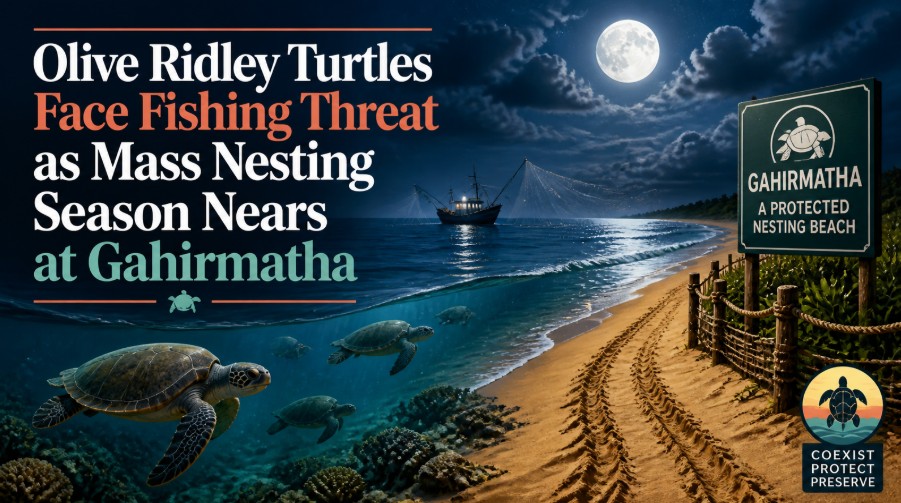
Representational Image
Gahirmatha, located in Kendrapara district, is Odisha’s only marine sanctuary and one of the world’s most important nesting grounds for Olive Ridley turtles. The endangered marine species travels thousands of kilometres to reach the coast, where female turtles gather on sandy beaches to lay eggs before returning to the sea.
However, environmentalists have warned that fishing trawlers operating inside restricted waters continue to endanger the turtles. Thousands are reportedly killed after becoming entangled in fishing nets, raising questions over the enforcement of seasonal fishing restrictions.
Illegal trawling raises conservation concerns
Mechanised fishing is prohibited from November 1 to May 31 within 20 km of the coastline between Dhamra and the Devi river mouth to protect Olive Ridley turtles during their breeding and nesting period.
Despite the restrictions, hundreds of trawlers allegedly enter the prohibited zone to take advantage of the availability of fish in the waters during these months.
Turtles caught in fishing nets often drown before they can reach the surface to breathe. Environmentalists say continued violations could undermine years of conservation efforts and have called for stronger surveillance and strict action against offenders.
Environmentalist Satyabadi Jena urged the Forest Department to intensify protection measures and ensure that illegal fishing is stopped.
He said those operating trawlers in restricted waters should face strict punishment, stressing that authorities must ensure the turtles can reach nesting beaches, lay their eggs and return safely to the sea.
Previous nesting concerns deepen alarm
The conservation concerns have also been heightened by claims that Olive Ridley turtles failed to undertake mass nesting at Gahirmatha last year.
Lawyer Devdutt Sethy said the turtles had returned without carrying out the expected mass nesting, warning that continued threats to their safety could further affect their population.
He urged the Odisha Forest Department to treat turtle protection as a priority, particularly during the crucial nesting period.
Olive Ridley turtles are an important part of the marine ecosystem, and their protection is considered essential for maintaining ecological balance along the Odisha coast.
Questions over patrol infrastructure
The Supreme Court, in 2004, assigned responsibilities for protecting Olive Ridley turtles to the Forest Department, Coast Guard, Marine Police and Fisheries Department.
As part of the protection arrangements, the Forest Department was provided with three high-speed boats to patrol the Gahirmatha coastline. However, reports that all three vessels had become non-operational have raised concerns about the department’s ability to monitor the protected waters effectively.
The department has also faced criticism over its alleged failure to prevent trawlers from entering restricted areas in previous years.
Forest Department says preparations are in place
Rajnagar Divisional Forest Officer Varadaraj Gaonkar said the department had made arrangements for the protection period beginning November 1 and continuing until May 31.
He said steps had been taken to ensure that the speedboats remained operational and that the department had put its protection infrastructure in place.
According to Gaonkar, 14 protection camps and two offshore protection camps have been prepared to strengthen surveillance along the coast and in adjoining waters.
The coming weeks will be crucial as the turtles begin arriving at Gahirmatha. Environmentalists say effective coordination among the Forest Department, Coast Guard, Marine Police and Fisheries Department will be essential to prevent illegal fishing and ensure a safe nesting season.