
The fashion industry has always been driven by creativity, innovation, and changing consumer preferences. From traditional clothing designs to modern digital fashion, the industry continues to evolve with technology. One of the most significant technological developments transforming the fashion world today is Generative Artificial Intelligence (Generative AI).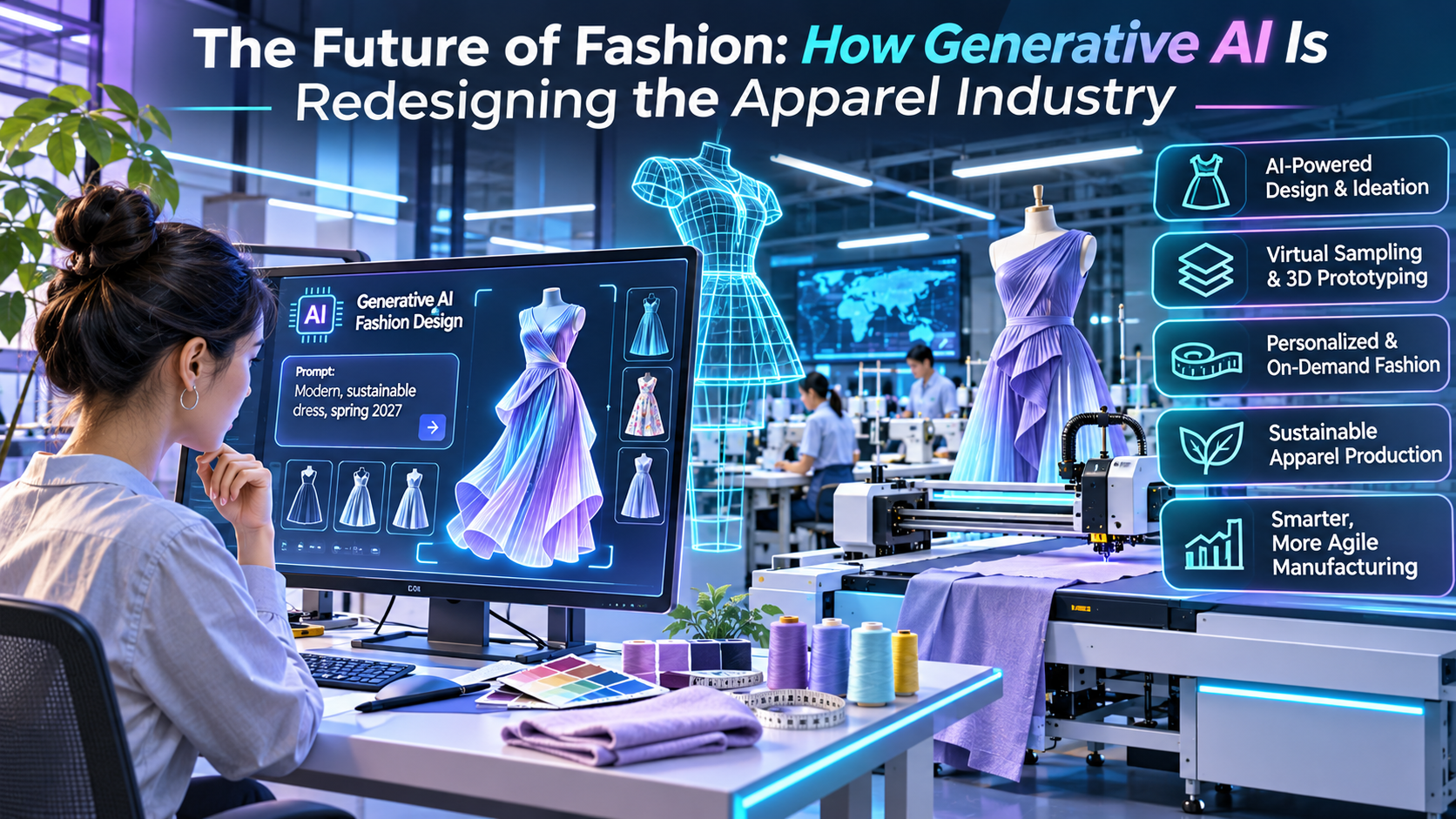
Generative AI is changing how fashion brands design clothes, predict trends, manufacture products, and connect with customers. It enables designers to create new patterns, experiment with unique styles, generate realistic clothing images, and develop personalized fashion experiences. As technology continues to advance, Generative AI is becoming an important tool in shaping the future of the apparel industry.
Understanding Generative AI in Fashion
Generative AI is a type of artificial intelligence that can create new content, such as images, designs, patterns, text, and videos, based on the data it has learned.
In the apparel industry, Generative AI can help designers develop innovative clothing concepts, explore different fabric combinations, create digital prototypes, and visualize garments before they are physically produced.
For example, a fashion designer can use an AI-powered tool to generate multiple dress designs by simply entering a text description, such as “a modern floral summer dress with sustainable fabric.” Within seconds, AI can generate several design ideas.
This technology saves time, encourages creativity, and makes the design process more efficient.
Transforming Fashion Design and Creativity
One of the biggest impacts of Generative AI is its ability to transform the fashion design process.
Traditionally, designing a garment involves sketching, selecting fabrics, creating patterns, and developing samples. These processes can take considerable time and resources.
Generative AI makes this process faster by:
-
Creating multiple clothing designs from simple text prompts.
-
Suggesting new colours, prints, textures, and patterns.
-
Helping designers experiment with different styles.
-
Generating innovative collections based on current trends.
-
Supporting designers in developing unique fashion concepts.
AI does not replace human creativity; instead, it acts as a creative assistant that helps designers explore more possibilities.
Personalized Fashion and Customer Experience
Today’s consumers want clothing that reflects their personal style, preferences, and lifestyle. Generative AI helps fashion brands provide more personalized shopping experiences.
By analyzing customer preferences, purchase history, and browsing behaviour, AI systems can recommend clothing styles that match individual tastes.
For example, an online fashion platform can suggest outfits based on a customer’s preferred colours, body measurements, budget, and previous purchases.
AI can also support virtual try-on experiences, allowing customers to visualize how different outfits may look before purchasing them.
This improves customer satisfaction, reduces uncertainty while shopping, and creates a more engaging shopping experience.
AI-Powered Trend Forecasting
Fashion trends change rapidly. Identifying future trends is essential for brands to remain competitive.
Generative AI can analyze large amounts of information from social media, fashion shows, online searches, customer reviews, and shopping patterns.
Using this information, AI can help fashion companies identify:
-
Emerging colours and patterns.
-
Popular clothing styles.
-
Changing consumer preferences.
-
Seasonal fashion trends.
-
Potential future market demands.
This allows brands to make better decisions about their upcoming collections and respond more quickly to changing fashion trends.
Revolutionizing Apparel Manufacturing
Generative AI is not limited to designing clothes; it is also influencing apparel manufacturing.
Fashion manufacturers can use AI-powered systems to improve production planning, optimize fabric usage, and reduce unnecessary material waste.
AI can help manufacturers by:
-
Optimizing garment patterns to minimize fabric wastage.
-
Supporting production planning and scheduling.
-
Identifying possible design and manufacturing errors.
-
Improving quality inspection through AI-powered image analysis.
-
Reducing production time and operational costs.
When combined with automation and smart manufacturing technologies, AI can help create a more efficient and productive apparel industry.
Promoting Sustainability in Fashion
Sustainability is one of the biggest challenges facing the global fashion industry. Overproduction, textile waste, and excessive resource consumption have increased the need for environmentally responsible practices.
Generative AI can contribute to sustainable fashion in several ways.
First, AI-based demand forecasting can help brands estimate how much clothing consumers are likely to purchase, reducing unnecessary production.
Second, AI-powered design tools can help designers optimize fabric layouts and reduce material waste.
Third, virtual sampling and digital prototyping can reduce the need for multiple physical samples, saving fabric, water, energy, and transportation resources.
Therefore, Generative AI has the potential to support a more sustainable and responsible fashion industry.
Digital Fashion and Virtual Clothing
Another exciting development is the emergence of digital fashion.
Generative AI allows designers to create digital garments that exist in virtual environments. These garments can be used in virtual fashion shows, social media content, digital avatars, gaming environments, and virtual shopping platforms.
Digital fashion offers new opportunities for designers and fashion brands to experiment without producing physical garments.
It also provides a platform for creative expression, where designers can develop futuristic outfits, unusual textures, and imaginative clothing styles that may be difficult to manufacture in the real world.
Challenges of Generative AI in the Apparel Industry
Although Generative AI offers many benefits, its adoption also comes with certain challenges.
Copyright and intellectual property: AI-generated designs may raise questions about ownership, originality, and the use of existing designers’ work in training data.
Job transformation: Some traditional tasks may become automated, requiring fashion professionals to develop new digital and technical skills.
Data privacy: Using customer information for personalized recommendations requires responsible data management and privacy protection.
Quality and accuracy: AI-generated designs may look attractive digitally but may not always be practical to manufacture.
High implementation costs: Advanced AI tools, infrastructure, and employee training can be expensive for small fashion businesses.
To overcome these challenges, fashion companies must adopt AI responsibly while maintaining human creativity, ethical practices, and quality standards.
The Future of Generative AI in Fashion
The future of the apparel industry will likely involve closer collaboration between human designers and artificial intelligence.
As Generative AI technology develops, we can expect more advanced applications, including:
-
AI-assisted fashion collections designed around individual customer preferences.
-
More realistic virtual fitting rooms.
-
Automated design-to-production workflows.
-
Smart clothing recommendations.
-
Greater use of digital samples and virtual fashion shows.
-
More efficient and sustainable manufacturing processes.
In the coming years, fashion brands that successfully combine creativity, technology, and sustainability will have new opportunities to stand out in the competitive global market.
Conclusion
Generative AI is reshaping the apparel industry by transforming the way clothes are designed, produced, marketed, and purchased. From AI-powered design and personalized shopping to trend forecasting, digital fashion, and sustainable manufacturing, this technology is opening new possibilities for the fashion world.
However, the true potential of Generative AI lies not in replacing human designers but in empowering them with innovative tools to work more creatively and efficiently.
The future of fashion will be a combination of human imagination and artificial intelligence. As the industry continues to embrace digital transformation, Generative AI will play an increasingly important role in creating a smarter, more personalized, innovative, and sustainable apparel industry.