
Mumbai, Sep 5: Indian stock markets finally found some relief on Friday after four consecutive sessions of losses, with the Sensex rising more than 360 points as investors returned to select metal, banking and oil and gas stocks. A positive trend across major Asian markets and easing concerns over an immediate US Federal Reserve rate hike helped improve sentiment, although profit booking and continuing geopolitical tensions kept the gains in check.
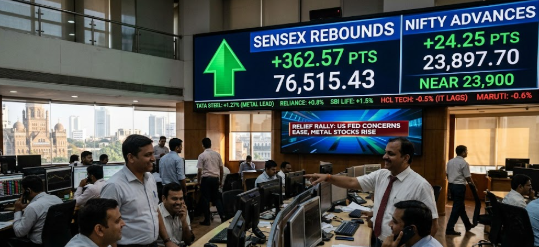
The BSE Sensex climbed 362.57 points, or 0.48 per cent, to close at 76,515.43, after moving sharply higher during the day. It touched an intraday high of 76,883.14, gaining as much as 730 points from the previous close before giving up some of those gains.
The NSE Nifty 50 rose 24.25 points, or 0.10 per cent, to end at 23,897.70. The index briefly crossed the closely watched 24,000 mark and reached 24,005.75, but selling at higher levels prevented it from holding those gains.
The recovery came after a difficult run for the domestic market. Investors used the recent decline as an opportunity to selectively buy stocks, particularly in metals, financial services and energy. Tata Steel was among the strongest performers, while Reliance Industries, SBI Life and HDFC Life also attracted buying interest.
However, the buying was far from universal. HCL Technologies, Bharti Airtel and Maruti Suzuki were among the major stocks that ended lower. The divergence between gainers and losers reflected the cautious mood among investors, who are increasingly focusing on individual companies and sectors rather than making broad market bets.
Market participants said Friday’s rise was largely a relief rally. Vinod Nair, Head of Research at Geojit Investments, said easing concerns over an imminent US Federal Reserve rate hike supported the recovery, but profit booking at higher levels and continuing geopolitical tensions in the Middle East restricted the market’s upside.
Global markets provided an additional boost. Hong Kong’s Hang Seng rose 1.74 per cent, South Korea’s KOSPI gained 1.64 per cent, and Japan’s Nikkei 225 advanced 1.28 per cent. China’s Shanghai Composite, however, ended 0.30 per cent lower. European markets remained largely flat during the day, while US stocks had closed more than 1 per cent higher in the previous session.
For Indian investors, the global interest-rate outlook remains particularly important. Expectations surrounding the Federal Reserve have been shifting rapidly, with every major US economic reading influencing the direction of global equities, bond yields and currencies. Any indication of higher-for-longer US interest rates could put pressure on emerging markets, including India, by strengthening the dollar and affecting foreign investment flows.
Crude oil is another concern. Brent crude was around $95.14 a barrel, remaining elevated amid geopolitical uncertainty. Higher oil prices can have a direct impact on India’s economy because of the country’s dependence on imported energy. A prolonged rise could increase input costs for businesses, put pressure on inflation and widen the import bill.
Foreign investors have also remained cautious. Foreign Institutional Investors sold equities worth ₹2,345.87 crore on Thursday, while domestic institutional investors continued to provide support to the market. Strong domestic buying has helped absorb some of the selling by overseas investors, but sustained foreign outflows could continue to make the market volatile.
Friday’s recovery therefore offers some encouragement, but it is too early to call it a clear change in the market trend. The Nifty’s inability to remain above 24,000 after briefly crossing the level shows that investors are still cautious about chasing gains.
Going forward, the market is likely to take its direction from the US Federal Reserve’s policy signals, global bond yields, crude oil prices, geopolitical developments and foreign fund flows. At the same time, domestic institutional buying and company-specific developments could create opportunities in selected stocks.
For now, investors appear to be taking a measured approach—buying selectively when valuations become attractive, while remaining ready to book profits when markets move sharply higher. Friday’s rebound has broken the recent losing streak, but the next few sessions will be crucial in determining whether it develops into a sustained recovery or remains a short-term bounce.