
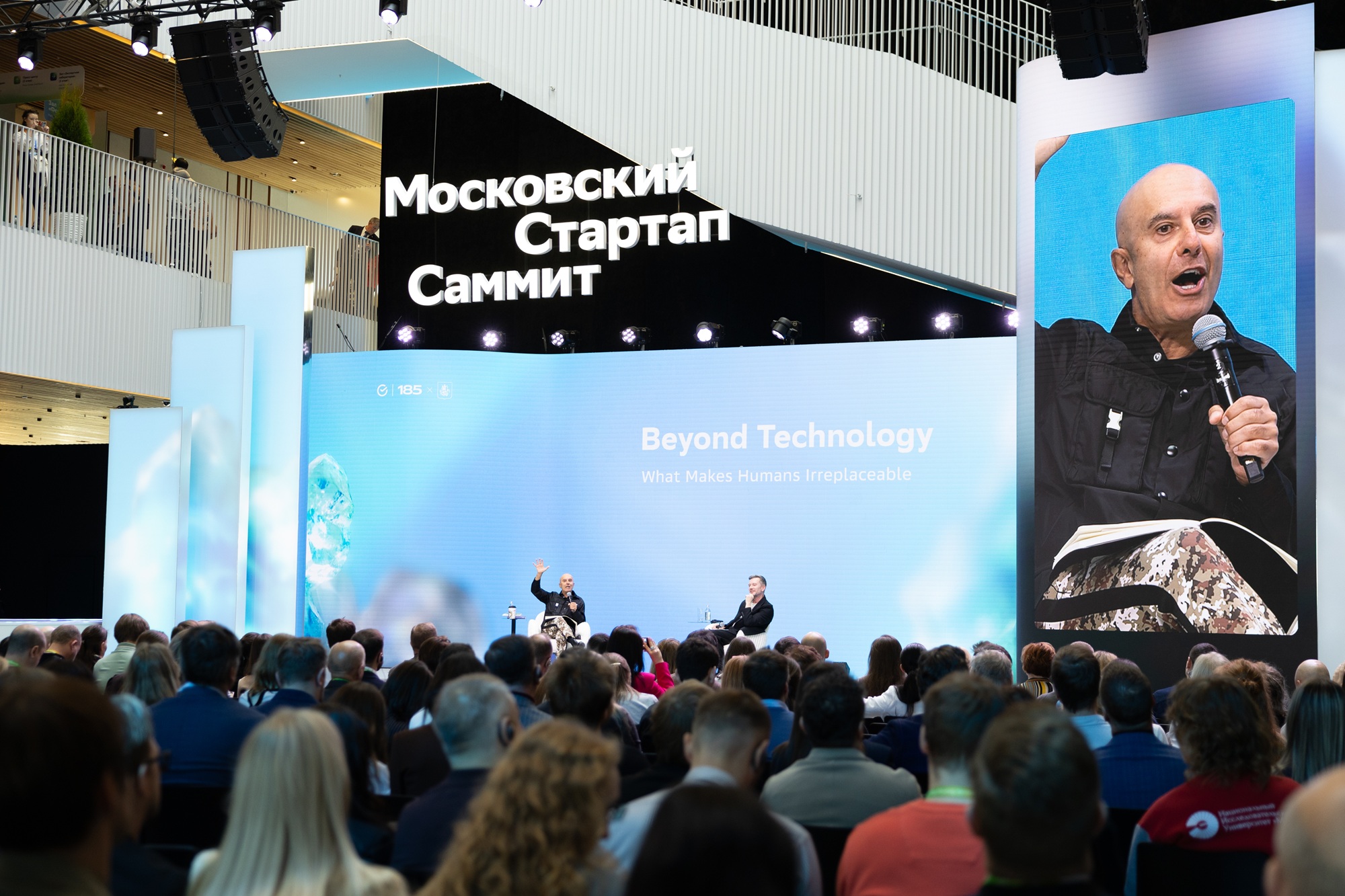
September 30, 2026, Moscow: A discussion between Robin Sharma, a world-renowned leadership expert and bestselling author of The Monk Who Sold His Ferrari and The Leader Who Had No Title, and Evgeny Tikhonovich, Editor-in-Chief of RBC Style and host of the Quality of Life programme, took place at the Moscow Startup Summit. The conversation focused on the role of leaders in an era of rapid advances in artificial intelligence and unprecedented uncertainty.
At the beginning of the discussion, Herman Gref, President and Chairman of the Executive Board of Sberbank, introduced Robin Sharma, whom he has known for many years, as one of the most inspiring speakers of our time. Mr. Gref noted that Sharma‘s philosophy is reflected in the way he lives and in his ongoing commitment to self-discovery.
H.U.M.A.N.: Be Human, Not a Machine
In his talk, Robin Sharma introduced a leadership philosophy built around the acronym H.U.M.A.N. In his view, the paradox of our time is that the more technology businesses adopt, the more human their leaders need to become.
“It is essential that artificial intelligence helps people rather than replacing their humanity. Technology should be our servant, not our master,” Sharma stressed.
He explained each element of his framework as follows:
- H (Humility) – As you become more successful, it is important to become humbler.
- U (Unkillable) – The ability to grow stronger in a world of volatility and instability.
- M (Mastery) – The ability to create products and services that have never existed before.
- A (Awake) – Mindfulness and self-awareness. Success should make us more conscious and aware, something robots are incapable of.
- N (Nuts) – A willingness to be a little crazy. You need to be a little crazy to bring your vision to life and change the world, even when others laugh at you.
Sharma quoted George Bernard Shaw, noting that great people adapt the world to themselves rather than adapting themselves to the world. “If people aren’t laughing at you, you’re not doing anything significant,” he added.
How to Build a Great Company and Understand a Billionaire
During the discussion, Evgeny Tikhonovich raised the subject of team management. Sharma argued that great companies avoid the trap of having “one genius and a thousand followers.” Instead, they build organizations with “a thousand Picassos”, empowering many individuals to become leaders. “Hire the best. Cutting corners on talent is the most expensive mistake a business can make in the long run,” the expert said.
Sharma also shared his observations on the psychological profile of billionaires, many of whom he has worked with for years. According to him, they share a stoic indifference to other people’s opinions, an almost irrational belief in themselves and a willingness to act despite ridicule. They are always striving for more: what they already have is never enough. However, their drive is often fueled by resentment stemming from a lack of love in childhood. “They are relentless in overcoming challenges, but the greatest danger for a successful leader is falling in love with a single formula for success and shifting from an offensive strategy to a defensive one,” Sharma cautioned.
According to the speaker, great companies are obsessed with achieving tenfold growth. The goal of a business should not be to make money, but to deliver ten times more value to customers. “Money is the result of the value you create. Steve Jobs was obsessed with creating amazing products, not making money, and that is what made Apple great,” he noted.
“The Robot and the Gardener”: A Metaphor for the Future
Evgeny Tikhonovich asked Sharma about his upcoming book, The Robot and the Gardener, scheduled for publication in 2027. The speaker explained the metaphor behind the title, warning of the risk of a “Frankenstein scenario” in which technology robs us of our humanity. The gardener represents our connection to the earth, our history and our mortality, all of which we must protect.
“We can learn a great deal from the dead by reading their epitaphs. Robots represent the beauty of technology, but the gardener represents our soul,” the author explained.
Productivity Practices: Less Is More
During the practical part of the discussion, Robin Sharma offered startup founders a series of unconventional recommendations. He argued that most people confuse busyness with productivity and that 80% of their daily activities are a waste of time.
“Stop using jargon. Tell stories the way people did in caves. Robots can’t do that,” Sharma advised. He recommended that leaders adopt the “five-hour rule”: outstanding entrepreneurs work effectively for five hours a day and devote the rest of their time to recovery. He also advised taking a full week off every quarter to generate new ideas, cutting out unnecessary communications and scheduling a weekly digital detox.
“You become more competitive when you get enough sleep. When you take a vacation to come up with new ideas. When you exercise instead of being a workaholic. When you have good relationships with your family. When you use technology to work effectively rather than feeding your destructive habits with it,” Sharma emphasised.
In response to a question about work-life balance, Sharma noted that success begins to work against a leader after their very first achievements. Consistency in practice, he argued, matters more than talent. He cited basketball player Kobe Bryant, who started training at 5 a.m., knowing that his competitors would not be able to do the same.
Three Pieces of Advice for Business Founders
At the end of the session, Robin Sharma offered three key recommendations for business founders:
Spend a week in solitude in a quiet place and write down a comprehensive vision for your business and your life.
Work on your inner self so that you no longer need external validation.
Take your mental and physical health seriously and live in accordance with your values.
“When I was 23, I thought that if I flew on a private jet, lived in a big house, drove a Ferrari and became famous, then everything would change. But in reality, none of that matters. What matters is your health and your family’s health. What matters is building a great business and creating wonderful products that amaze the world. Love and serving others matter. So please, live your life in a way that keeps these things in mind,” Robin Sharma concluded.
The Moscow Startup Summit, dedicated to technology entrepreneurship and open innovation, is taking place on September 29–30 at SberCity, Sber’s smart city, in the facilities of the largest School 21 campus. The summit is organised by the Government of Moscow and Sber.
The central theme of the 2026 event is the transformation of five key industries through startup-driven technological solutions: medicine and biotechnology; education and creative industries; agriculture and food production; construction and urban development; and smart devices and robotics.
The summit aims to facilitate deals between investors, corporations and startups in these industries and shorten the path from technology to practical implementation. The programme features talks by leading figures in innovation and representatives of unicorn startups, startup pitches, an exhibition of more than 100 Russian and international technology startups ranging from seed-stage ventures to pre-IPO companies, and a technology awards ceremony honouring corporations, investors, universities and media organisations that have contributed to the development of the country’s innovation ecosystem.