
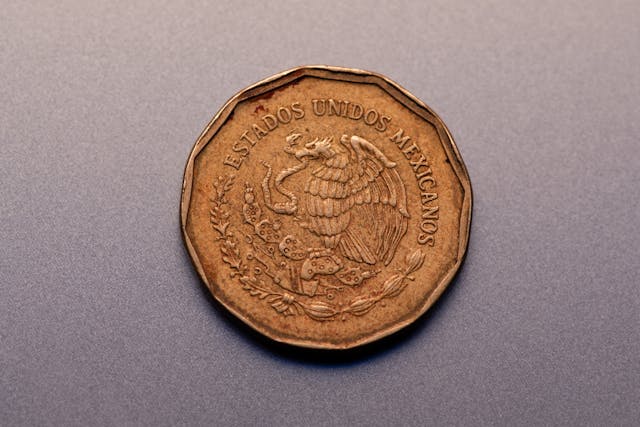
The Mexican peso posted moderate gains in early trading, strengthening toward the 18.17 per dollar level as investors remained cautious ahead of the U.S. Federal Reserve’s highly anticipated monetary policy announcement. While a 25-basis-point rate cut is broadly expected, market sentiment has softened amid expectations that the easing cycle may be limited, reflecting the increasingly cautious tone adopted by several Fed officials.
In early trading hours, the USD/MXN briefly touched 18.31, driven by a modest rebound in the U.S. dollar index against major global currencies. This initial move prompted some profit-taking following the peso’s recent appreciation. However, the Mexican currency later recovered as traders adjusted positions ahead of the Fed’s policy statement.
On the domestic front, November inflation in Mexico came in higher than forecast, indicating persistent pressures in certain components of the price index. Despite the upside surprise, the data failed to materially alter market expectations for Banco de México’s (Banxico) policy outlook. Investors largely viewed the reading as a temporary fluctuation rather than a structural shift, maintaining confidence in Mexican assets supported by strong macroeconomic fundamentals and still-attractive interest rate differentials.
From a technical standpoint, the USD/MXN pair is trading in a sensitive zone, showing signs of overbought conditions that raise the risk of a near-term correction if the dollar loses momentum following the Fed’s decision. The Relative Strength Index (RSI) signals fading strength, while key moving averages suggest immediate support in the 18.15–18.20 range.
Globally, financial markets continue to be shaped by expectations surrounding U.S. monetary policy. Interest rate futures currently imply an over 85% probability of a quarter-point rate cut, though expectations for deeper easing into 2026 have weakened amid persistent inflation risks and the more hawkish stance adopted by several major central banks. This mix has fueled volatility across emerging markets and heightened selectivity in capital flows.
Adding to the uncertainty is speculation surrounding the White House’s future appointment of the Federal Reserve Chair in 2026, when Jerome Powell is set to step down. The possibility of a shift toward either a more aggressive or more accommodative policy approach is already influencing long-term dollar expectations and emerging-market currency performance.
Despite these global headwinds, the Mexican peso has shown resilience, supported by solid economic fundamentals, sustained demand for peso-denominated assets, and Mexico’s relatively stable macroeconomic framework compared to other emerging economies. While caution remains the dominant market theme, traders continue to view the peso as well-positioned to find support at key technical levels if the Fed delivers a measured policy message.
Outlook
The peso’s advance reflects a balance between global uncertainty and domestic strength. Although inflation surprised to the upside and the U.S. dollar posted early gains, the Mexican currency held firm, aided by favorable technical signals and steady investor confidence. With markets closely monitoring both U.S. monetary policy and the Fed’s future leadership direction, volatility is likely to persist, but the peso continues to outperform many of its emerging-market peers.
Photo by Mahmoud Yahyaoui: